


Movement notes
The beat rate describes the rhythm of a mechanical watch’s balance. It is usually given in beats per hour, also called vibrations per hour, or in hertz.
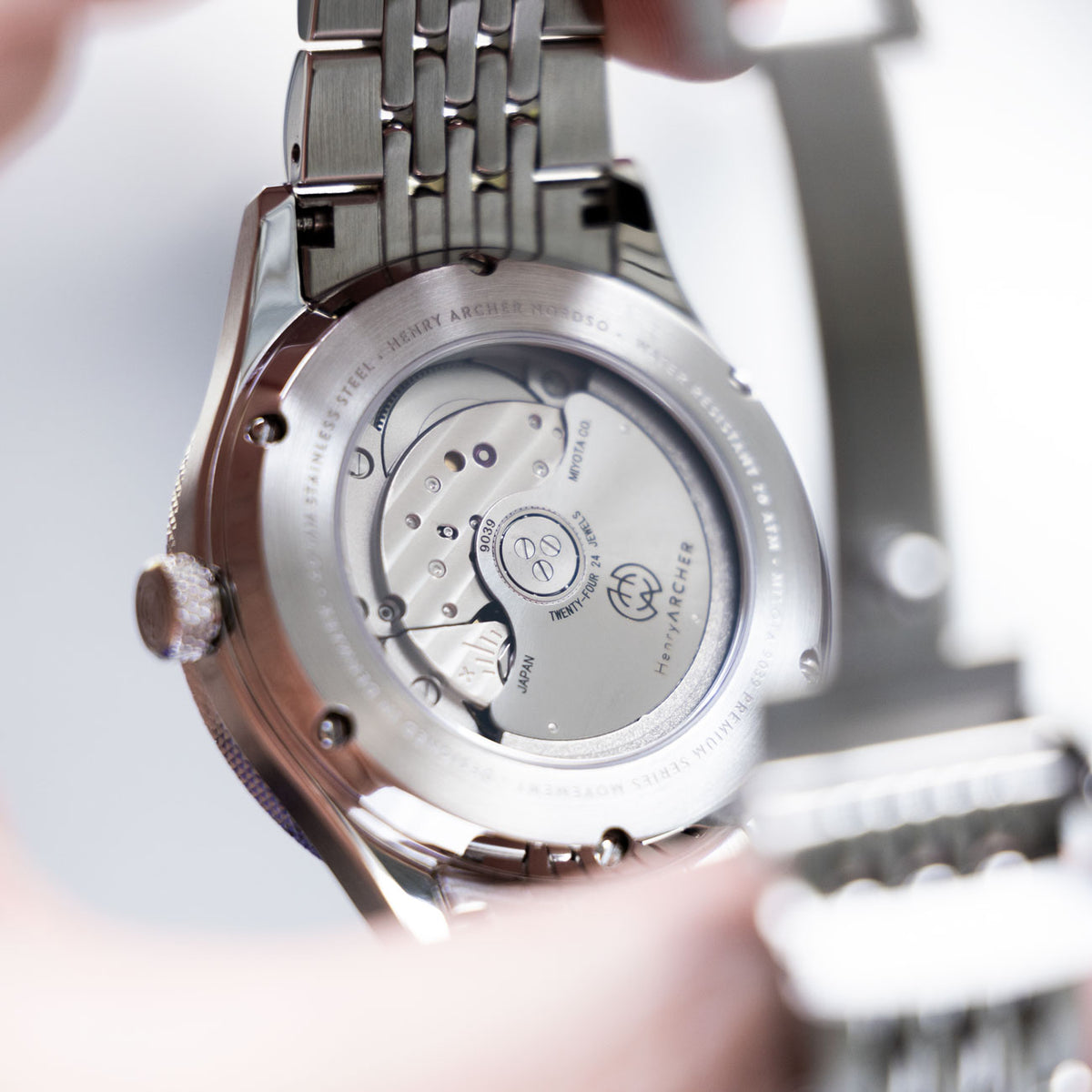
In focus
Reading the numbers
| Beats per hour | The number of balance half-swings in one hour |
|---|---|
| Hertz (Hz) | Complete balance oscillations per second |
| 28,800 bph | 8 beats per second, or 4 Hz |

From beats per hour to hertz
A beat is one half-swing of the balance. Two beats make a complete back-and-forth oscillation. A movement running at 28,800 beats per hour therefore makes eight beats each second, or four complete oscillations: 4 Hz.
Common examples include 18,000 bph at 2.5 Hz, 21,600 bph at 3 Hz, 28,800 bph at 4 Hz and 36,000 bph at 5 Hz.
What you see on the dial
In a conventional mechanical watch, the seconds hand advances in small steps as the escapement releases the gear train. More steps each second create a finer-looking sweep.
At 28,800 bph, those eight small advances per second are visible in many watches using Miyota’s 9000-series movements. The motion looks different from the single jump per second of a typical quartz watch.
What a higher beat rate changes
Beat rate is one part of a movement’s design. The size and construction of the balance, the mainspring, friction and regulation all matter too. A higher frequency gives the escapement more impulses per second and changes the energy demands placed on the movement.
The number alone does not tell you a watch’s accuracy or power reserve. Those are separate specifications. For example, Miyota specifies approximately 42 hours of running time for the 4 Hz 9015.
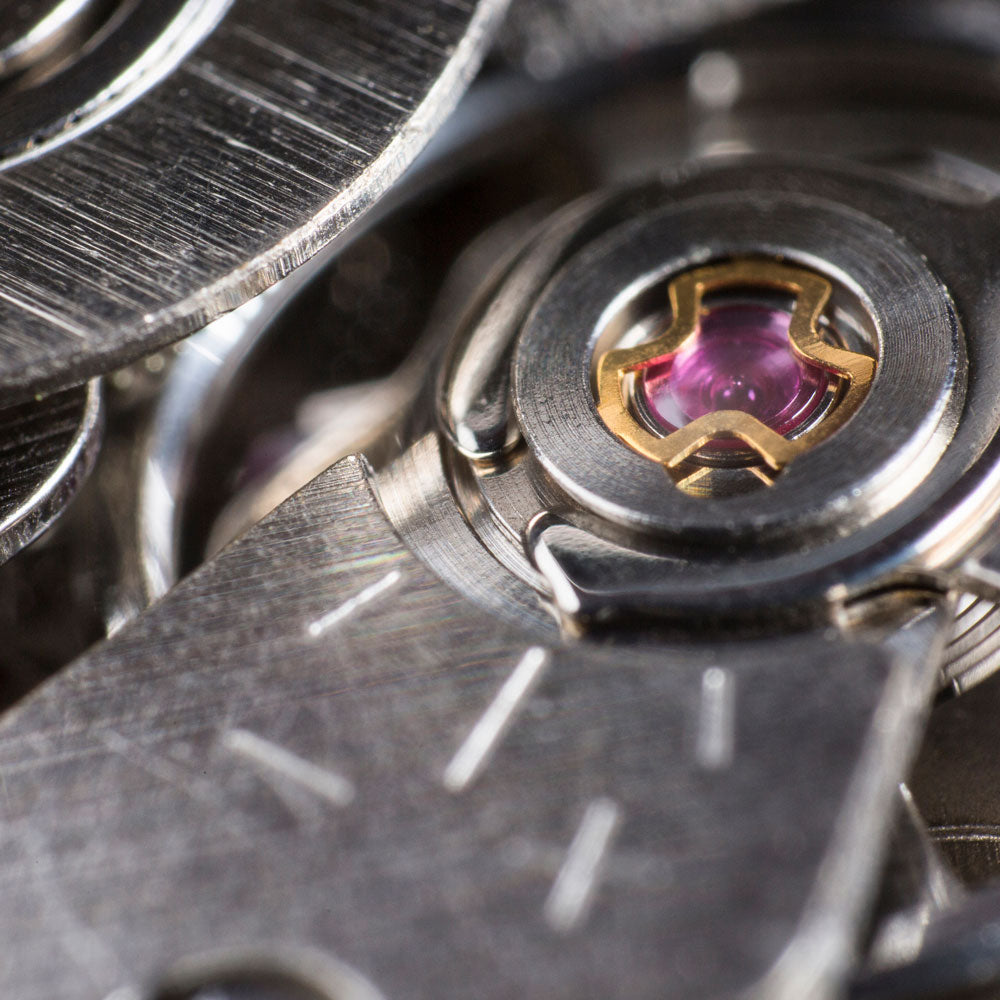
The movements in our watches
The Miyota 9015 and Miyota 9039 both run at 28,800 bph. The same frequency appears in the 9075 GMT and 9122 triple-calendar movements.
For an owner, beat rate is an easy way to understand the motion of the seconds hand. To learn how the rest of the movement works, explore our individual movement guides.
Continue reading
Read next
The slim automatic movement with a quick-set date.
The no-date movement, crown positions and everyday use.
What to check when a mechanical watch changes its rate.


